
Casa de Sefarad in Córdoba is a museum and cultural centre dedicated to preserving the history, customs and memory of the Sephardic Jewish people. It is located in the heart of Córdoba’s Jewish Quarter, on Calle Judíos, directly opposite the Córdoba Synagogue.
Its permanent exhibition explores subjects such as the Sephardic diaspora, the Judeo-Spanish language, Sephardic music, religious celebrations, everyday life, the Inquisition and the figure of Maimonides. It is therefore a particularly worthwhile visit for anyone who wants to understand Córdoba’s Jewish heritage beyond its monuments.
Casa de Sefarad is not notable for its size, but for the historical context it provides. After visiting its rooms, nearby places such as the Synagogue, Plaza de Tiberíades and the statue of Maimonides take on a much deeper meaning.
Practical information for visiting Casa de Sefarad
| Information | Visitor details |
|---|---|
| Address | Calle Judíos, at the corner with Calle Averroes, 2 |
| Location | Córdoba’s Jewish Quarter, opposite the Synagogue |
| Regular opening hours | Tuesday to Saturday, from 11:00 a.m. to 6:00 p.m. |
| Opening hours in July and August | From 10:00 a.m. to 3:00 p.m. |
| Closed | Sundays and Mondays |
| General admission | €5 |
| Senior citizens and visitors with disabilities | €4.50 |
| Students | €4 |
| Groups | Contact the museum for prices and conditions |
| Recommended visiting time | Between 45 and 60 minutes |
| Telephone | 957 421 404 |
Opening hours and admission prices may change on public holidays or when special activities are taking place. Before visiting, it is advisable to check the information published on the official Casa de Sefarad website.
What is Casa de Sefarad?
Casa de Sefarad, also known as Casa de la Memoria, is a privately run museum and independent cultural project whose aim is to preserve and promote Judeo-Spanish and Sephardic heritage.
The exhibition combines documents, objects, works of art, musical resources and historical explanations. The visit does not focus solely on the expulsion of the Jews from the kingdoms of Castile and Aragon in 1492. Instead, it examines a much broader process: the lives of Jewish communities, medieval persecution, forced conversions, the diaspora and the preservation of Sephardic identity in other territories.
In addition to its permanent exhibition, Casa de Sefarad operates as an active cultural centre. It organises concerts, conferences, exhibitions, presentations, seminars and activities related to Jewish culture and memory.
The Córdoba Municipal Tourism Institute also describes it as a cultural centre dedicated to recovering a tradition that forms part of the city’s historical identity.

What does Sefarad mean?
Sefarad is a biblical Hebrew place name traditionally identified with the Iberian Peninsula. It is the origin of the term Sephardic, which is used to refer to Jews of Spanish origin and their descendants, as well as their culture and traditions.
Following the expulsion of 1492, many Sephardic communities settled in North Africa, the eastern Mediterranean, the Balkans, Italy and other territories. Despite the distance, many preserved songs, recipes, stories, celebrations and linguistic traditions connected with the Iberian Peninsula for centuries.
One of the most important elements of this cultural continuity was Judeo-Spanish, also known as Sephardic or Ladino. The language developed from the varieties of Spanish spoken by the expelled communities and gradually incorporated vocabulary from Hebrew, Turkish, Greek, Arabic, French and other languages.
Casa de Sefarad helps visitors understand that Sephardic culture did not disappear when these communities left Spain. It continued to evolve throughout the different territories of the diaspora.
A historic house in Córdoba’s Jewish Quarter
 The museum stands at the corner of Calle Judíos and Calle Averroes, within one of Córdoba’s most frequently visited historic areas.
The building was restored to house the exhibition and retains heritage features dating from the late 14th century. Over time, it was occupied by craftspeople and different families, and during the 20th century it was used as a communal house, with residents living around a shared courtyard.
It should not therefore be interpreted as a completely intact medieval Sephardic home. Its interest lies both in its surviving historic architectural features and in the way its rooms have been adapted to explain Sephardic memory.
Its location makes it easy to combine the museum with other places in the neighbourhood. Within a few minutes, visitors can reach the Córdoba Synagogue, Plaza de Tiberíades, the statue of Maimonides and the Municipal Souk.
You can find more information about the surrounding area in our Córdoba travel guide.
What to see at Casa de Sefarad in Córdoba
The exhibition is organised into nine themed rooms. Although each area covers a different subject, together they form a continuous journey through Sephardic history and culture.

The diaspora and the Judeo-Spanish language
The room dedicated to the diaspora explains the gradual deterioration of Jewish life on the Iberian Peninsula, the persecution and forced conversions, and the subsequent dispersal of Sephardic communities across different territories.
The expulsion of 1492 is not presented as an isolated event. Acts of violence during the 14th century had already severely weakened the Jewish communities. In Córdoba, the attacks of 1391 caused deaths, displacement and conversions.
The room dedicated to Judeo-Spanish shows how language became a fundamental means of preserving identity. Stories, songs, sayings, prayers and family traditions were passed down through it for generations.
It was not simply a form of medieval Spanish that remained unchanged, but a living language that continued to evolve through contact with other cultures.
The Synagogue, everyday life and celebrations
Another part of the exhibition examines the synagogue as a place of prayer, study, education and community gathering.
This explanation is particularly useful before visiting the Córdoba Synagogue. While the historic building allows visitors to see a medieval religious space, Casa de Sefarad helps explain how it was used and the role it played within the community.
The rooms devoted to domestic life and festive cycles introduce visitors to more everyday matters, including birth, marriage, food, work, family life, death and religious celebrations.
These spaces present history from a different perspective. Rather than focusing only on rulers, wars and persecution, they show how daily life was organised and how traditions were passed from one generation to the next.
Maimonides and Sephardic women
Moses ben Maimon, better known as Maimonides, was one of the leading Jewish thinkers of the Middle Ages. He was born in Córdoba in the 12th century and became an influential philosopher, physician, jurist and scholar of Jewish religious tradition.
His family was forced to leave the city because of the political and religious circumstances of the period. After living in several territories, Maimonides eventually settled in Egypt.
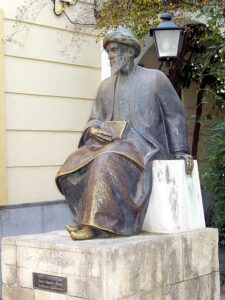
The room dedicated to him connects his intellectual legacy with Córdoba, but also with the experience of displacement and exile. After leaving the museum, visitors can continue to the nearby Plaza de Tiberíades, where his well-known statue stands.
The Women & Sefarad room recovers the memory of women who worked as physicians, poets, thinkers and librarians, as well as other Jewish and converso women who are often given little space in traditional historical accounts. A collection of paintings by Córdoba artist Luis Celorio gives them a face and introduces their biographies.
The Inquisition and Sephardic music
The room dedicated to the Inquisition uses historical documents to explain the workings and consequences of the Tribunal of the Holy Office.
A significant part of its activity was directed against Jewish converts to Christianity, known in Spanish as judeoconversos, who could be accused of secretly continuing to practise Judaism. The exhibition helps visitors understand that persecution did not end with the expulsion of 1492, as many convert families remained in Spain and lived under suspicion for generations.
Music also occupies an important place in the museum. Songs and ballads helped Sephardic communities pass down stories, celebrations and family experiences.
As Sephardic communities settled in different territories, these compositions continued to evolve within the various musical traditions of the Mediterranean. Casa de Sefarad also organises concerts and workshops, so it is worth checking its programme before visiting.
Casa de Sefarad and the Córdoba Synagogue: the differences
Their proximity can cause some confusion, but Casa de Sefarad and the Córdoba Synagogue are not the same monument.
| Casa de Sefarad | Córdoba Synagogue |
|---|---|
| It is a museum and cultural centre. | It is a medieval religious building. |
| It explains Sephardic culture and history. | It preserves the architectural space of a historic synagogue. |
| The visit is divided into nine rooms. | The visit focuses on the building itself. |
| It is privately managed. | It is managed by the Regional Government of Andalusia. |
| Admission is charged. | Admission is free under the current official conditions. |
The Synagogue was built in the early 14th century and had several different uses after the expulsion of the Jewish population. It normally opens from Tuesday to Sunday, although public holidays, restoration work and other temporary closures may affect access. Visitors should check the latest information on the official Regional Government of Andalusia website.
The best option is to visit both places. Casa de Sefarad provides the historical and cultural context, while the Synagogue allows visitors to see an authentic medieval religious building.
How long does it take to visit Casa de Sefarad?
There is no compulsory length of visit, but we recommend allowing between 45 minutes and one hour. The museum can be explored more quickly, although much of its value lies in its texts, documents and explanations. Moving through the rooms too quickly can make them seem like an unrelated collection of objects.
Visitors with a particular interest in Maimonides, Judeo-Spanish, the Inquisition or the diaspora may need a little longer.
How to get to Casa de Sefarad
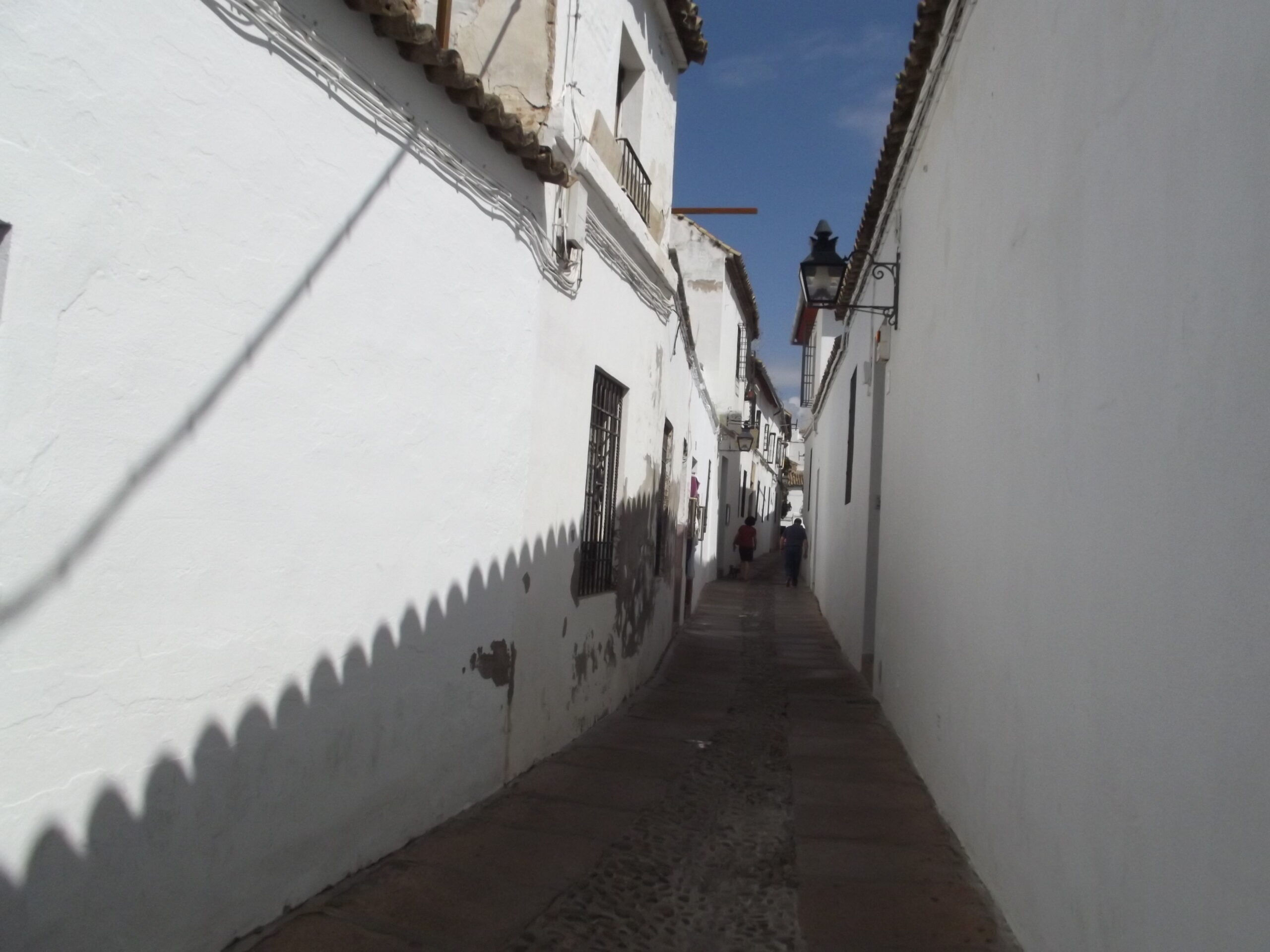
Casa de Sefarad is located in a mainly pedestrian area of the historic centre, so the best way to reach it is on foot.
From the Mosque-Cathedral
From the area around the Mosque-Cathedral, you can walk through the Jewish Quarter until you reach Calle Judíos. It is a short route that passes through some of the historic centre’s most characteristic streets.
To plan the rest of your visit, you can consult our itinerary on what to see in Córdoba in one day.
From the Almodóvar Gate
The Almodóvar Gate is one of the most direct entrances to the neighbourhood. From there, simply continue along Calle Judíos, passing Plaza de Tiberíades and the statue of Maimonides.
Trying to drive directly to the museum is not recommended. The streets are narrow, several areas are pedestrianised and traffic restrictions apply in different parts of the historic centre.
A route through the Jewish Quarter from Casa de Sefarad
A straightforward walking route can follow this order:
- Almodóvar Gate
- Calle Judíos
- Plaza de Tiberíades and the statue of Maimonides
- Casa de Sefarad
- Córdoba Synagogue
- Municipal Souk
- Plaza de Maimónides
- Continue towards the Mosque-Cathedral
This route allows visitors to explore the museum first and then apply what they have learned when viewing the Synagogue and the rest of the neighbourhood.
Córdoba’s historic centre is a World Heritage Site and preserves traces of Roman, Islamic, Jewish and Christian cultures, as explained in the official UNESCO listing for Córdoba.
To understand how all these places developed and relate to one another, the guided tour of the Mosque-Cathedral and Córdoba’s Jewish Quarter connects the monuments with the city’s urban and cultural history.
Tips for making the most of your visit
Check the opening hours before you go
The museum closes earlier in July and August, and its opening hours may change on public holidays.
Visit the Synagogue as well
They are different places, but together they provide a much more complete explanation of Córdoba’s Jewish heritage.
Do not rush through the rooms
The museum is primarily interpretive, and much of its interest lies in the texts and historical documents.
Check the cultural programme
Concerts, workshops and conferences can complement the permanent exhibition.
Ask about accessibility in advance
The museum website does not provide sufficiently detailed information about access conditions in all rooms.
Is Casa de Sefarad worth visiting?
Casa de Sefarad is worth visiting for anyone who wants to understand Córdoba’s Jewish past rather than simply admire the architecture of the Synagogue.
It is particularly interesting for visitors drawn to medieval history, Maimonides, Sephardic culture, Judeo-Spanish, traditional music or the Inquisition.
It does not have the monumentality of the Mosque-Cathedral or the scale of the Alcázar of the Christian Monarchs. Its value is different: it provides context, testimony and explanations about a part of history that is not always visible when walking through the city.
If you have more time to explore Córdoba, you can include this visit in our itinerary on what to see in Córdoba in two days or extend your route with a walk through Córdoba’s historic centre.
Frequently asked questions about Casa de Sefarad
Is Casa de Sefarad the Córdoba Synagogue?
No. Casa de Sefarad is a cultural museum located opposite the Synagogue. They are separate visits, although they complement one another.
How much is admission?
General admission costs €5. Reduced prices are available for students, senior citizens and visitors with disabilities.
What are the opening hours?
It normally opens from Tuesday to Saturday, from 11:00 a.m. to 6:00 p.m. In July and August, it opens from 10:00 a.m. to 3:00 p.m.
How long does the visit take?
We recommend allowing between 45 minutes and one hour to explore the rooms comfortably.
Do I need to book in advance?
Advance booking is not stated as compulsory for individual visitors. Groups and visitors interested in special activities should contact the museum beforehand.
Can I visit it together with the Synagogue?
Yes. The two sites are only a few metres apart and can easily be visited one after the other as part of a route through the Jewish Quarter.
